

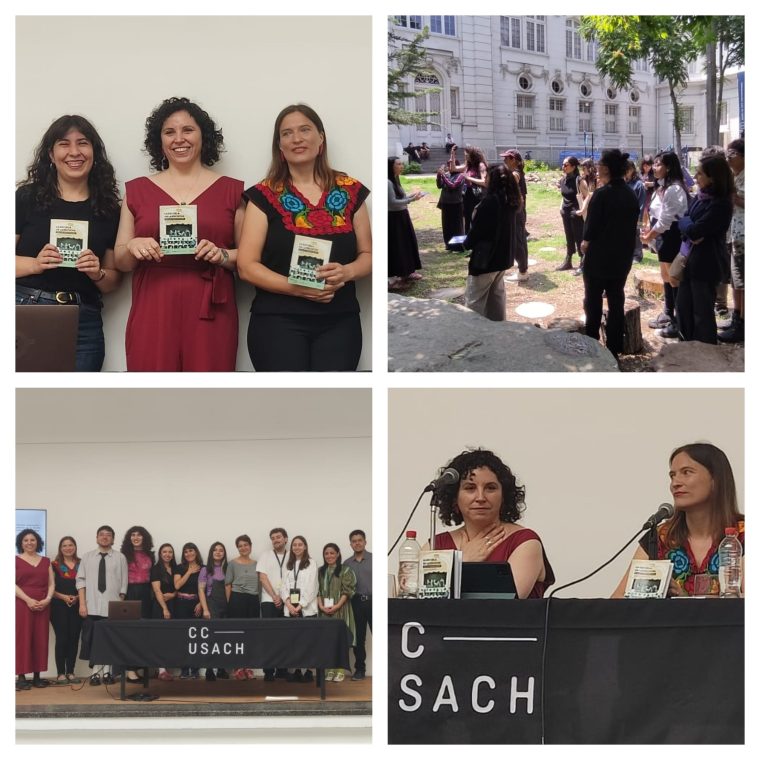
Launch of Teacher’s Manual at the Museum of Contemporary Art
Organized by the USACH Cultural Corporation, the Teacher’s Manual: Music of Written Tradition in TISA (Transitions, Exchanges and Sensitization of the Arts) was launched on Friday, December 12th at the Museum of Contemporary Art in Quinta Normal. CMUS researchers Eileen Karmy and Daniela Fugellie presented it to the public.
The professor from Playa Ancha University spoke about the history of the Listening School and the development of this document, which was created in collaboration with the Usach Cultural Corporation. She said, “The manual suggests two types of activities. One is simpler, which can be done during a conversation, using only a music player; and the other is a bit more complex, requiring a space other than the classroom, for example, an outing.” The academic from Alberto Hurtado University discussed a classroom listening activity using Chilean music from the written tradition: “The goal is to raise awareness about how a piece can evoke something Chilean for us. Why? Because of the way the instruments sound, the rhythms, or the melodies. Or also, ‘no, because I didn’t find anything Chilean while listening, but I was very surprised to hear that it could be an orchestra.'”
Before the launch of the Teacher’s Manual, there was a roundtable discussion with other presentations. The Pedacito de Verdad collective spoke about various initiatives, such as the “Creative Research Laboratory for Everyday Life,” which includes playful and educational workshops, all with a community focus. Next, the representative from Taller de Patrimonio (Heritage Workshop) discussed the different measures taken since 2015 for the care and preservation of the Liceo de Aplicación (Application High School). Finally, Yenny Díaz from the Salvador Allende Museum of Solidarity explored its history, the nomadic exhibition during the dictatorship, and the activities they carry out with the community to encourage visits to the museum. There was also time for an outdoor tour called “Transformations: Water Invocations” in the MAC gardens, where we learned about the different states of water found in nature and in various devices.