

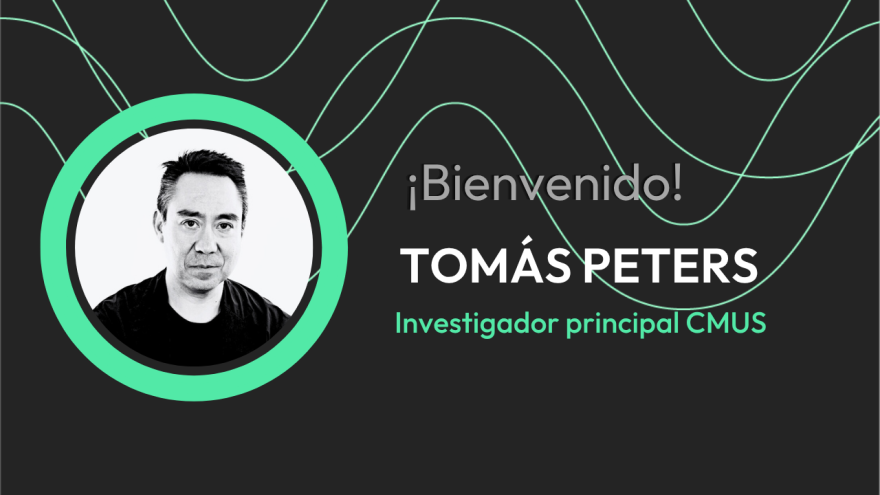
Tomás Peters: “My integration into the (CMUS) team seeks to add analytical dimensions to the relationship between State and culture”
In this new cycle of the Center for Musical and Sound Cultures (CMUS), Tomás Peters has joined as principal investigator. He is a sociologist, holds a Master’s degree in Art Theory and History, and a PhD in Cultural Studies from Birkbeck, University of London. He is a professor in the Faculty of Communication and Image at the University of Chile. His research areas are the sociology of art and culture, cultural studies, and the history and theory of cultural policies in Latin America. He is the author of the book Sociology(ies) of Art and Cultural Policies (Metales Pesados, 2020). The unrelenting gap: Cultural policies and inequality in Chile (OPC, 2023), Decantations. Politics and cultural democracy: a global dialogue (FCEI, 2025) edited with Steven Hadley and An oblique journey. The intellectual itinerary of Nelly Richard (Metales Pesados, 2025).
He has followed CMUS since its inception. “Their work has been invaluable,” he comments. “The research team has not only introduced new questions and theoretical-methodological contributions to understanding the transformation of music, sound, and listening in Chilean society, but has also made an undeniable contribution to the public sphere regarding the role of cultural production in processes of social change and transformation. For me, it has been especially relevant how CMUS has generated debates and emerging questions both in academia and in the design and development of public policies. This aspect seems particularly important to me for engaging with the society in which we live. In this sense, the effort and commitment that my colleagues have demonstrated all these years seems especially relevant to me, since they have produced, through an interdisciplinary research strategy, a new way of studying music, sounds, listening, and musical cultures in a world marked by increasing social complexities.”
-How did you come to join the Núcelo?
I became familiar with CMUS’s work very early on, as I know several colleagues on the team, especially Carla Pinochet. When I was fortunate enough to witness the project’s launch at GAM, I fell in love with its theoretical and methodological approach, and above all, with how they tackled the issue of music from an interdisciplinary perspective, deeply committed to the field of music. When I received Christian Spencer’s invitation, I didn’t hesitate: I accepted and joined a team I greatly respect and admire. In just a few weeks, we worked together to design a project that would continue the work already done and add new dimensions of analysis, such as the relationship between cultural policies, music, and subjective well-being. In short, since joining the team, the discussion of these topics has been very stimulating and challenging, as I believe that, collectively, CMUS is venturing into cutting-edge research in the cultural sphere.
-With your lines of research focused on public and cultural policies, how will you complement the work at CMUS?
This new phase of CMUS seeks to explore how interdisciplinary research in music and society can contribute to the design, implementation, and evaluation of public policies. Considering all the work and learning generated within the team, it became even more important to advance towards strengthening the relationship between knowledge generation and decision-making within the State, which opens up new perspectives for methodological work and theoretical exploration. For this reason, my joining the team aims to add analytical dimensions to the relationship between the State and culture; or, rather, how the processes and transformations in music, listening, sounds, and musical cultures contribute to the generation of subjective well-being and, with these findings, generate input for the debate on contemporary cultural policies. My historical work has focused on understanding how cultural policies operate in society, and in that sense, my incorporation into the project seeks to enrich the discussion already advanced by my colleagues at CMUS.
-You are directing the Fondecyt project “Power, influence, knowledge and change in the configuration of recent cultural institutions in Chile: towards a sociology of cultural policies” (2024-2026). In broad terms, what is it about? Who else is on your team?
This Fondecyt grant has been a wonderful and stimulating project. It essentially seeks to understand how Law 21.045, which created the Ministry of Cultures, Arts, and Heritage, was conceived or crafted—as I prefer to say. Its objective is to understand the sociological dimensions at play in creating a cultural institution. I’m interested in how, for example, power dynamics were exercised in the legislative debate among the various stakeholders, as well as in the use of the Lobbying Law to influence certain decisions. At the same time, I’m concerned with how knowledge (studies, reports, theoretical discussions) is used in cultural policy decision-making within the ministry, and also how forms of cultural participation have changed in Chile in recent years. In short, it’s a project that brings together anthropological, historical, communicational, and sociological perspectives. In fact, the research team includes colleagues from all these disciplines in order to approach the problem from an interdisciplinary perspective.