Learn about CMUS’s achievements between 2022 and 2025 (Part 2)
During the first period of the Center for Musical and Sound Cultures (CMUS), a large number of outreach activities were carried out, networks were established with cultural institutions, and the School of Listening was implemented. Here we share the second part of its achievements.
Last December, the first phase of CMUS, which ran from 2022 to 2025 and was funded by the Millennium Initiative of the National Research and Development Agency (ANID), came to close. The project brought together a network of researchers in converging disciplines (music studies, social anthropology, sociology of culture, and education) with an inter- and transdisciplinary perspective across four regions and seven universities in the country. Through collaborative work, the project focused on the following lines of research: Communities, territories, and participation; Education and heritage; and Economies, industries, and policies of culture.
Training of students and researchers
The training of young researchers was a strategic dimension of the CMUS, aimed at linking educational processes with the research lines of the center. This model was organized into three levels of training—undergraduate, master’s, and doctoral—and included thesis development, participation in seminars and workshops, as well as integration into research networks and academic production. The students incorporated into the center were thesis students from formal programs in areas related to the social sciences, arts, and humanities, both in Chile and abroad. Their integration was based on the affiliation of their advisors or co-advisors with the center—as principal or associate researchers.
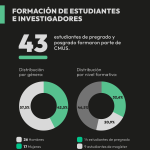
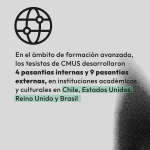
43 undergraduate and graduate students participated in CMUS, of whom 17 were women and 26 were men. In terms of their academic level, 14 were undergraduate students, 9 were master’s students, and 20 were doctoral students. Regarding advanced training, 4 internal internships and 9 external internships were carried out at academic and cultural institutions in Chile, the United States, the United Kingdom, and Brazil.
Promotion: press and events
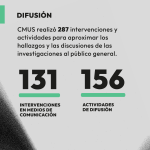
The CMUS Communications Program was established through news updates on its website, monthly newsletter, social media, and its own YouTube channel. During 2024 and 2025, this structure was strengthened with increased content distribution and visibility gained through interviews, columns, press releases, and coverage in national and international media outlets such as El País, Ciper, and Interferencia, among others, totaling 131 appearances.
A significant milestone was the international impact of the academic article by researchers from the Nucleus published in Science Advances, which was cited by media and platforms of wide reach such as The New York Times, Scientific American, University of Auckland News, Forbes Japan and Folha de S. Paulo, showing that the public projection of the work of the CMUS could transcend the academic circuit and reach a global audience.
Over these three years, 156 outreach activities were carried out, including book launches, seminars, exhibitions, concerts with commentary, workshops, panels, and documentary screenings, aimed at general audiences, students, teachers, and cultural professionals. In 2025, this initiative reached a more mature stage, with a broad range of activities targeting the general public, cultural sector professionals, students, and teachers. These activities included conferences, seminars, workshops, written and graphic materials, audiovisual productions, exhibitions, and book launches, covering topics such as genre and the music industry, heritage, exile, classical music, Mapuche music, cultural policies, urban music, artistic mediation, and listening as a cultural phenomenon. The diversity of formats and audiences demonstrates that the outreach strategy did not focus on a single theme or audience type, but rather expanded across various fields of interest and levels of specialization.
Projection to the External Environment
School of Listening
The most innovative, sustained, and relevant initiative of the period was the School of Listening (PME), developed in two successive cycles and conceived as an experimental social research methodology based on sound, music, and listening, geared toward educational communities. The project represented the most complete form of methodological transfer from the CMUS and demonstrated a high degree of coherence with the Center’s objectives, as it took the concepts, approaches, and questions from sound and aural studies and transformed them into a replicable, open, and geographically adaptable pedagogical tool.
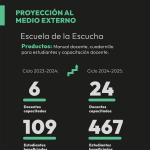
The first cycle (2023-2024) included a design and teacher training phase, followed by a pilot implementation in six secondary schools located in four regions of the country. The project involved the development of a teacher’s manual and a student workbook, synchronous teacher training, and open access publication of the materials. In total, six teachers participated in the training phase and 109 students participated in the school implementation during this cycle.
The second cycle (2024-2025) represented a significant expansion in scale, coverage, and results. This iteration of The Listening School trained 24 teachers and implemented 22 workshops in ten regions of the country, reaching 467 secondary school students. It also produced six open-access audiovisual modules and developed an evaluation process using surveys and qualitative analysis. In terms of innovation, The Listening School was particularly relevant because it transformed a field of research still underrepresented in school education—the study of sound and listening—into a concrete, open, replicable, and geographically diverse pedagogical approach.
Collaboratives Networks
From its inception, the CMUS defined the development of formal collaboration networks as a strategic focus aimed at ensuring institutional continuity, strengthening interdisciplinary work, and creating conditions for high-level scientific production through three main agreements. First, the agreement with the Chilean Museum of Pre-Columbian Art established a collaboration focused on developing joint activities related to research, cultural mediation, and knowledge dissemination, including the exchange of researchers, the organization of events, and the creation of spaces for dialogue between academic research and cultural practices.
Secondly, the collaboration with the Chilean Society of Musicology facilitated the integration of the Center into specialized disciplinary networks, promoting the active participation of its researchers in conferences, academic workshops, and scientific discussion forums at the national and international levels. CMUS also participated in some of the Society’s decisions regarding international guests for its conferences.
Finally, the agreement with the Cultural Corporation of the University of Santiago, Chile, established in 2025, allowed the Center to expand its work into the area of audience development through the development and adaptation of the “School of Listening” program as a mediation tool in concert programs of traditional written music within secondary education contexts. These formal networks were characterized by their stability, their capacity to sustain initiatives over time, and their contribution to positioning the CMUS as a relevant actor in the field of musical and sound cultures in Chile.